Getting Comfortable on the Mat
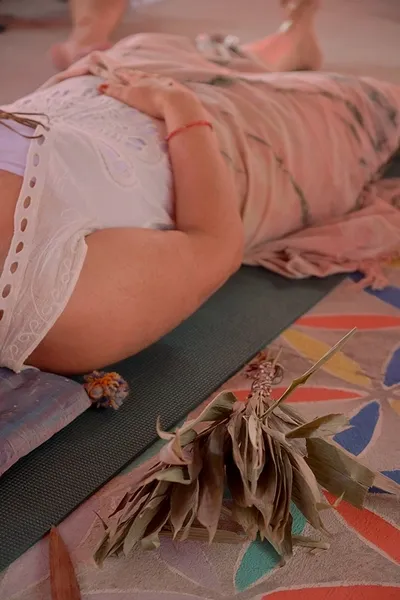
Once the session begins, you'll lie comfortably on a yoga mat, typically on your back.
You can adjust your position as needed and make yourself comfortable before settling in.
An eye mask may be used to reduce visual distractions and make it easier to turn your attention inward.
From there, your instructions are remarkably simple:
- Lie down comfortably
- Close your eyes
- Relax your body
- Listen to the music
- Remain present
- Allow your experience to unfold naturally
There is nothing you need to perform.
The Music Begins
Music plays an important role in the KAP experience.
Rather than serving simply as background sound, music helps create the progression and atmosphere of the session.
The musical journey may move through different rhythms, intensities, emotional tones, and periods of greater stillness.
Your job isn't to analyze the music or consciously respond to it.
Simply listen.
For many participants, closing their eyes and immersing themselves in the music makes it easier to move away from everyday thoughts and become more aware of what is happening internally.
What Does the KAP Facilitator Do?
While participants rest with their eyes closed, the facilitator moves through the space and facilitates the KAP process.
Depending on the session and individual participant, facilitation may involve working in proximity to different areas or energetic points of the body. At times, the facilitator may use light touch when appropriate and with consent.
Dr. Hart's role is not to dictate what you should experience.
Instead, she creates and facilitates the environment in which the process can unfold.
This distinction is important because KAP is not about performing for the facilitator or trying to create a particular reaction.
Each participant remains in control of their own participation throughout the session.
What Might You Feel During a KAP Session?
This is often the biggest question people have before attending.
The answer is: it varies.
Some participants experience noticeable physical, emotional, or sensory responses. Others have quieter, more introspective experiences.
You might notice:
Spontaneous Movement
Your body may feel inclined to move without consciously planning the movement.
This can range from subtle movements of the hands, arms, legs, or head to larger stretches or flowing movements.
Some participants move considerably.
Others barely move at all.
Both are completely valid experiences.
Physical Sensations
You may become aware of sensations such as warmth, coolness, tingling, vibration, heaviness, lightness, or changes in how different areas of your body feel.
These sensations may appear briefly, move, change, or disappear.
Emotional Responses
Emotions can sometimes surface during the experience.
A participant may laugh, cry, feel joy, experience sadness, or become aware of emotions that seem to arise unexpectedly.
If emotion arises, there is no need to suppress it or immediately understand why it appeared.
You can simply notice it and allow it to pass naturally.
Visual Experiences
With your eyes closed, you may notice colors, patterns, imagery, memories, or other internal visual experiences.
Other participants may experience no visual imagery whatsoever.
Again, neither response indicates whether the session was more or less meaningful.
Stillness and Deep Relaxation
Not every KAP experience is dramatic.
Some sessions may involve very little physical movement or emotional expression.
You may simply experience deep relaxation, quiet awareness, or a sense of stillness.
This can be just as much a part of the KAP experience as more noticeable responses.
What If Nothing Happens?
This is one of the most important things for first-time participants to understand.
You don't need to have a dramatic experience for your session to be worthwhile.
It's easy to see videos or hear stories about spontaneous movement, emotional releases, or powerful experiences and assume that's what KAP is supposed to look like.
It isn't.
People respond differently.
Your experience may be physical, emotional, contemplative, subtle, or difficult to describe.
Trying to make something happen can actually interfere with your ability to relax into the experience.
Instead of asking yourself, “Is it working?” try returning your attention to the music and allowing yourself to be present.
Are You Conscious and in Control During KAP?
Yes.
KAP does not require you to surrender control of yourself.
You remain aware and can respond to your environment throughout the session.
If you become uncomfortable, you can change positions, open your eyes, sit up, take a break, or stop participating.
Maintaining this sense of personal agency is an important part of creating a respectful KAP environment.
How Long Does a KAP Session Last?
Session formats can vary depending on the event, but you should allow additional time beyond the active KAP experience for orientation beforehand and a period of reflection afterward.
Your specific event registration will provide the scheduled start time, duration, location, and any preparation instructions.
Arriving on time is particularly important because the introductory portion helps establish the environment for the experience that follows.
What Happens When the Music Ends?
The transition out of the experience is generally gradual.
As the music becomes quieter and the active portion of the session concludes, you'll have time to remain on your mat, reconnect with your surroundings, and allow your body and mind to settle.
There is no need to immediately jump up or begin analyzing everything you experienced.
Give yourself a few moments.
Notice how you feel.
Breathe naturally.
And return to your surroundings at your own pace.
Reflection and Integration After KAP
Following the session, there may be an opportunity for participants to reflect on their experience.
Some people immediately want to talk about what happened.
Others prefer quiet reflection.
Both approaches are appropriate.
You may find it helpful afterward to journal, take a walk, spend some quiet time alone, hydrate, or simply notice how you feel during the hours and days following your session.
You don't necessarily need to assign meaning to every sensation, emotion, image, or movement you experienced.
Sometimes the most useful approach is simply to remain curious.
What Is an Online KAP Session Like?
The fundamental participant experience is similar, but instead of gathering in a shared physical space, you participate from your own home through a live online session.
Before beginning, you'll want to create a comfortable, uninterrupted space where you can lie down fully.
A yoga mat, comfortable clothing, quality headphones or speakers, and a stable internet connection can help create an environment where you can focus on the experience without distractions.
Dr. Hart provides instructions before the session and facilitates the experience remotely while participants listen to the music and engage in the process from their own spaces.
What Happens at Your First KAP Session?
Your first session isn't a test.
You don't need to understand Kundalini deeply, know how energy work is supposed to feel, or have previous experience with meditation or similar practices.
You also don't need to copy what anyone around you is experiencing.
Come as you are.
Lie down.
Close your eyes.
Listen to the music.
Allow yourself to relax.
And remain curious about whatever unfolds.
A Note From Dr. Noushin Hart
After more than three decades as a physician, my work has continually reinforced for me how individual the human experience can be.
I bring that same respect for individuality to the way I facilitate KAP.
I don't believe participants should feel pressure to move, release emotions, have visions, or experience something extraordinary. My intention is to create a supportive environment where you can feel comfortable letting go of expectations and simply experiencing what arises for you.
Your KAP experience belongs to you.
— Noushin Izadifar Hart, MD
Board-Certified Radiation Oncologist
Level 2 Kundalini Activation Process Facilitator
Frequently Asked Questions About KAP Sessions
What should I wear to a KAP session?
Wear loose, comfortable clothing that allows you to lie down and move freely if spontaneous movement occurs.
Do I need to bring a yoga mat?
For in-person sessions, check the specific event instructions to see whether mats are provided or whether you should bring your own. For online sessions, a yoga mat or another comfortable surface is recommended.
Do I need to know how to meditate?
No. KAP doesn't require meditation experience or a specific meditation technique.
Will everyone in the room have the same experience?
No. Even though participants experience the same session and music, individual responses can be very different.
What if I become emotional?
Emotional responses can occur. You don't need to suppress an emotion simply because it arises. You also remain free to open your eyes, sit up, take a break, or discontinue the session at any point.
Is KAP a medical treatment?
No. Kundalini Activation Process is an experiential practice and is not medical or mental health treatment. Dr. Hart's role as a KAP facilitator is separate from her practice of medicine, and participation should not replace appropriate medical or mental health care.
Experience a KAP Session With Dr. Noushin Hart
Understanding what happens during KAP can make your first session feel more approachable.
But reading about the experience and actually experiencing it are very different things.
You don't need to arrive with expectations.
You don't need to make anything happen.
You simply need to give yourself permission to be present and experience whatever naturally unfolds.
Ready to experience KAP?
Explore upcoming in-person KAP sessions with Dr. Noushin Hart or join a live online KAP experience from wherever you are.
View Upcoming KAP Sessions →